Globes
As with any area in which artificial lighting is used, people like to adjust the lighting level to meet their needs and create a more comfortable environment. Allowing the occupants of an area to reduce the lighting level can help reduce glare when there is excessive lighting levels. By reducing eye strain in office or school areas occupants are more comfortable and better able to focus on the task at hand, allowing for them to be more productive.
When dimming incandescent lamps, their power consumption is also reduced, producing running cost savings. Dimming an LED will not use less power however as the dimming protocol is different. A dimmed incandescent lamp also produces less heat which will help increase their operation life and protects the investment an end-user has made. LED’s do not produce the same degree of heat dimmed or otherwise.
Short answer: efficiency regulations phased out inefficient lamps, and 25 watts is now the maximum incandescent made. But you have not lost any light. A modern filament LED gives four to six times more light than the 25W incandescent it replaces, in the same vintage shapes — because watts were never a measure of brightness in the first place.
What changed
For some years the Australian Government, along with many others, has applied energy efficiency regulations that progressively phased out inefficient lamps. Non-LED lamps are now largely banned as imports, and incandescent globes survive only in decorative forms up to 25 watts.
Certain shapes and sizes can no longer be made as incandescent at all. The restriction is written as shape codes with the globe’s diameter in millimetres:
- A50 to A65 — the standard pear-shaped household globe
- PS50 to PS65 — pear, straight sided
- M50 to M65 — mushroom
- T50 to T65 — tubular
- E50 to E65 — ellipsoidal
In short: the everyday household shapes between 50 mm and 65 mm across. Larger decorative globes — our 95 mm, 125 mm and 150 mm styles, and the long tube shapes — are outside those sizes and can still be made.
Some of our vintage globes in the restricted sizes are still listed. Those are remainder stock. They are marked as limited and will not be restocked, so once they are gone they are gone. If you are choosing globes for a new fitting, or you want to be able to replace them in a few years, choose a filament LED rather than one of these.
Why wattage stopped being useful
Watts measure the power a globe consumes. They never measured light. Wattage only worked as a rough guide to brightness while every globe used the same inefficient technology, so a 60W always beat a 40W. Once LED arrived, the link broke completely.
Lumens are the number to compare
Lumens (lm) measure the light a globe actually produces. Comparing our own globes:
| Power | Light output | |
|---|---|---|
| Vintage Edison spiral filament (incandescent) | 25 W | 180 lm |
| Vintage E27 round bulb (incandescent) | 25 W | 100 lm |
| 8 Watt Dimmable Lantern Filament LED E27 | 8 W | 856 lm |
| 10 Watt Dimmable Filament LED E27 95mm | 10 W | 1,223 lm |
| 11 Watt Dimmable Filament LED E27 125mm | 11 W | 1,300 lm |
An 8 watt filament LED produces roughly five times the light of a 25 watt incandescent, using a third of the power. If you want more light, look for a higher lumen figure — not a higher wattage.
“But my light fitting says maximum 40 watts”
That marking is a safety limit on how much power the fitting may draw. It is not a brightness target and it is not a wattage you need to reach. Any globe at or below that figure is safe to use — including a 10 watt LED that is far brighter than the incandescent the limit was written for.
Will an LED look the same?
Our filament LEDs are made to replicate vintage styles as closely as possible — the same glass shapes, the same visible filament. The difference you may notice is colour.
Colour temperature is measured in kelvin (K). The lower the number, the warmer and more amber the light:
- 1800K–2000K — our vintage incandescent globes. Deep amber, the classic Edison glow.
- 2200K — our warmest filament LEDs. The closest match to a vintage incandescent.
- 2700K — our standard warm white LEDs. Still warm, slightly brighter and cleaner.
If you are replacing vintage incandescent globes and want the closest match, choose 2200K. If you want the room noticeably brighter, 2700K will give you that.
Where to look
Browse our LED globes — every listing shows its wattage, lumen output and colour temperature so you can compare directly. If you tell us which globe you have now and what you are trying to achieve, we will tell you which one to move to.
Our LED’s are made in two warm color temps 2200K and 2700K. Our current incandescent are around 1800K
When dimmed, LED lamps may become susceptible to a temporary or permanent flickering. Care in selecting the right lighting dimmer or controller for the desired LED lamp is important so the risk of LED flickering can be reduced. Sources of LED lamp flicker can come from a range of different locations and often at the same time, for example:
- Mains supply instability.
- Noise on the mains supply or dimming system.
- Dimming system not loaded sufficiently.
- Too many or too few LED lamps are being used per lighting circuit.
- LED driver design.
- Dimmer level set too low.
In order to accommodate the widest range of usage and dimming problems we have included a number of technical improvements to LED driver design that we include inside the globe cap. A range of globes now in their sixth generation of electronics to provide perfect dimming with no flicker regardless of load. We call this Enhanced dimming. This advanced chip also stops LED’s from remaining slightly lit when turned of at the switch.
Whilst LED dimming is now a reasonable proposition for most lighting situations it must be understood that this dimmed appearance is just an illusion. LED’s that are supplied by an Alternating current at 50- 60 htz do turn on and off 50 or 60 times a second. This makes it appear that they are on due to the imperceptible flicker rate. However it is possible to detect this flicker with a video camera running at say 30 frames per second. It may also be possible to detect when viewing moving objects lit by LED globes. Running water from a tap looks interesting for example.
We manufacture globes that cater for both bayonet and screw connections. The code allocated to each globe refers to the connection between the globe and the light socket. The codes beginning with an ‘E’ refer to an edison screw fitting whereby the globe screws into the light socket. The standard fitting is an E27(E26 for North America). The E14 (or E12 North America) is a smaller fitting generally used for lamps and chandeliers.
Codes beginning with a ‘B’ refer to bayonet fittings and are generally only found in Commonwealth countries. The B22 is the standard size, with B15 again generally used for lamps and chandeliers.
The E40 and E39 (North America) was traditionally an industrial fitting. Our goliath range of globes fall under this category.
Please make sure when you are ordering globes and light fittings that they are compatible.
Although the vast majority of our LED globes are made as dimmable, not all dimmers mechanisms will work correctly. All LED globes will require at least a Trailing Edge dimmer. Clipsal make a universal dimmer that can control a large range of bulb types. However Diginet now make a dimmer that in our testing has been the most applicable.
The Diginet MEDM Adaptive phase dimmer is the dimmer of choice which fits standard Australian wall plates.
The Diginet MEDM Adaptive Phase Dimmer is designed in Australia to provide optimised dimming of LED based lamps and drivers, this high quality, two-wire phase control wall plate dimmer has a minimum load rating of 2W, allowing it to adapt to a wide range of available LED drivers.
Although optimised for LED lighting loads, this dimmer also provides excellent compatibility with other common lamps types such as incandescent lamps, 12V halogen (dichroic) lamps /transformers and CFL’s.
E27 is the most common type of Edison Screw base, It is often referred to as ES. The number ..27 refers to the diameter of the globe’s cap. This type of base is also compatible with Compact Fluorescent Globes and LED globes. E27 is a 240 Volt bulb, as is a standard Bayonet B22.
We also stock E14 SES 240 Volt bulbs and now E40 GES 240 Volt bulbs
Whilst we do stock 110 Volt E26 and E12 components for those countries that use that standard, not all bulb shapes are available.
| Type | Volts | Size | Name |
|---|---|---|---|
| E5 | 18 | 05 mm | Lilliput Edison Screw (LES) |
| E10 | 30 | 10 mm | Miniature Edison Screw (MES) |
| E11 | 120/240 | 11 mm | Mini-Candelabra Edison Screw (mini-can) |
| E12 | 120 | 12 mm | Candelabra Edison Screw (CES) |
| E14 | 240 | 14 mm | Small Edison Screw (SES) |
| E17 | 120 | 17 mm | Intermediate Edison Screw (IES) |
| E26 | 120 | 26 mm | [Medium] (one-inch) Edison Screw (ES or MES) |
| BA9 | 240 | 9 mm | Miniature Bayonet Cap MBC |
| B15 | 240 | 15 mm | Small Bayonet Cap SBC |
| E27 | 240 | 27 mm | [Medium] Edison Screw (ES) |
| B22 | 240 | 22 mm | Bayonet Cap BC |
| E39 | 120 | 39 mm | (Mogul) Goliath Edison Screw (GES) |
| E40 | 240 | 40 mm | (Mogul) Goliath Edison Screw (GES) |
Phillips Dynalite system struggles with LED filament lamps due to technology gaps and the fact the system is leading edge dimming which isn’t always compatible with LED lamps.
To dim our Edison Filament LED lamps effectively without flickering you need a Dynalite DDBC120-DALI MultiMaster Dali Driver Controller with 1 dali loop and a Helvar 454 4x500W Leading/Trailing Edge Dimmer.
The Dynalite DDBC-120-DALI must be connected to the existing Dynalite System using proprietary Dynet protocol and the Helvar 454 will be connected to DDBC-120-DALI output. The process and installation in not invasive or complicated.
Color temperature is a measure of the light bulb’s color when illuminated, and is measured in degrees Kelvin (K). The higher the number, the whiter and then bluer, the colour.
LED technology has come a long way since first introduced. Initially LED globes were known for having a very white light. New developments have now enabled LED globes to replicate the same warmth as traditional and vintage incandescent globes. When a warm light is required look for colour temperature of 3000K or less.
To match our range of Vintage filament style bulbs we have introduced an LED range with a 2200K color temperature. The newer LED’s also have a filament length that mimics the wire filament design of Vintage bulbs and also provides a very close approximation of the full color spectrum.
For each bulb in our catalog there is a downloadable test report for all parameters.
We manufacture a range of globes with various lumen levels. Lumen is a measure of brightness. The higher the lumen number the brighter the light.
At Edison we specialise in ambient lighting so our globes are in the low to mid lumen range. Our new range of vintage LED globes provide a warm, low to medium light.
Most of our fittings leave the bulb visible which suits our ambient globes. With the bulb exposed it is important that the glare does not blind the eye.
Watts are a measure of the amount of energy required to to run electrical products, whereas lumens are a measure of the amount of light produced. The more lumens in a light bulb, the brighter the light.
With a move to new energy-efficient LED technology, the number of lumens available per watt is much higher, so they produce more light whilst using less energy. In other words, a 12 Watt LED can produce as much light as a 75 Watt incandescent globe.
When you are looking at wattage, it is all about energy use. It has been drastically reduced with LED. This means you will pay less for electricity to light the same area.
LED lamps have very different response to dimming than previous generations of lamps. It is important to remember that the pre-set scenes of a lighting control system will need to be adjusted if a project has upgraded to LED lamps.
LED lamps could also have a very different dimming curve to previous generation of lamps. A lighting control system will need to compensate for LED dimming site effects such as:
Dead travel this is when adjusting the dimmer channel output seems to have no relative effect to the LED lamp light output.
Popping on a LED lamp may require a minimum level before it is able to start producing light. For some lamps this might be as high as 10%-15%.
Not all LED lamps are dimmable, only lamps that have been specifically designed by the manufacturer as dimmable may be dimmed. Attempting to dim a non-dimmable LED lamp or using an incompatible dimming method will result in undesirable behaviour or complete lamp failure. Dimmable lamps may only be compatible with certain dimming techniques so it is important the correct method is used.
Low voltage LED strip lighting is now a widely used component in domestic and industrial lighting systems. These products have been manufactured as a roll of single LED’s mounted to adhesive tape that can be attached to an aluminium extrusion to create lighting of almost any length.
This type of lighting is used along cupboard feet, overhanging shelves, stair treads, bathrooms, and all manner of lighting components and fittings.
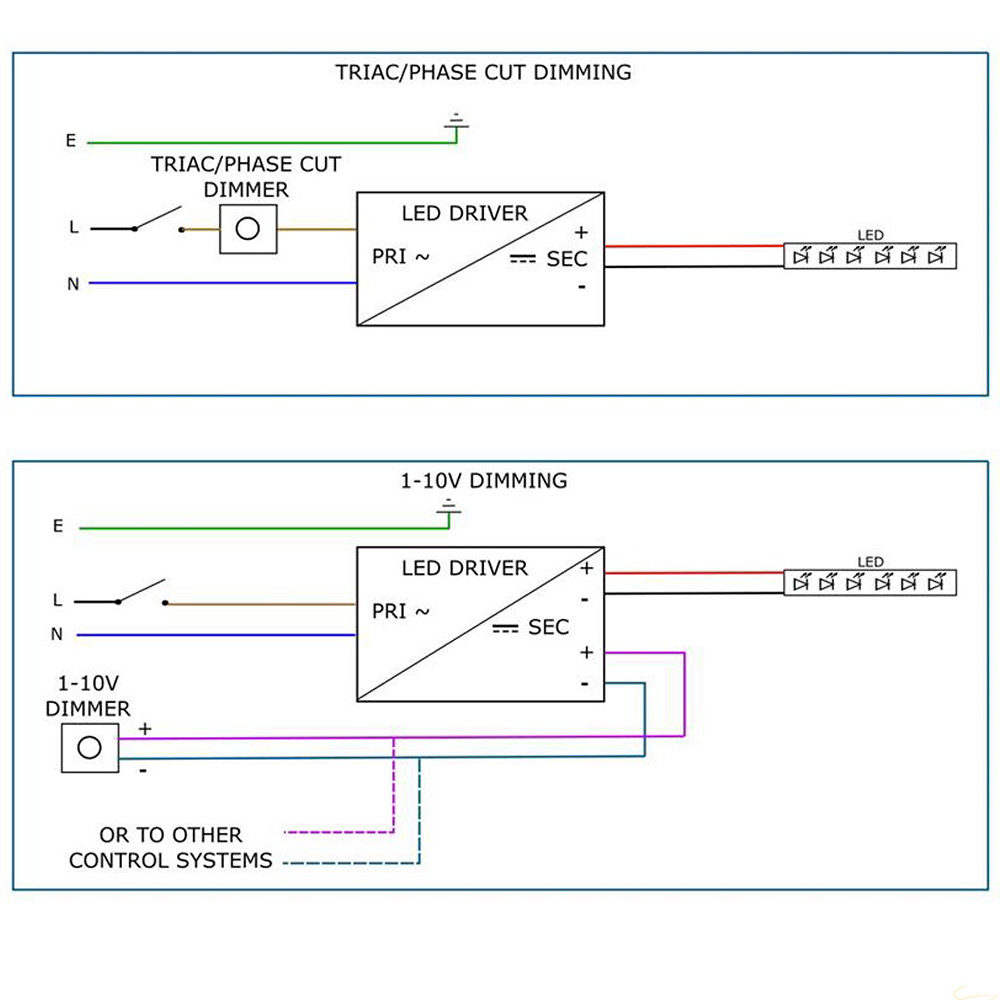
Essentially a driver/transformer supplies low voltage as either 12 or 24 volts from mains supply. In order to make dimmable we need to supply a driver that can allow dimming.
There are two methods to achieve dimmability for Low voltage LED strip lighting.
0-10 Volt dimmer
0-10V dimming is a dimming standard, originally developed for fluorescent dimming ballasts (updated from 1-10V). It has since been widely adopted for drivers of LED lighting. The 0-10V dimming driver receives a voltage level signal from 0 to 10VDC, via a compatible 0-10V dimming device, along two dedicated wires. The driver then controls the LED brightness level utilising pulse width modulation (PWM), which is basically switching on and off at a rate undetectable to the human eye.
Advantages:
- There are many systems currently available that control 0-10V found in modern homes, hotels, shopping centres etc.
- It is more efficient than traditional dimming methods.
- Good stable dimming can be achieved, regardless of power load.
Disadvantages:
- It requires two dedicated wires from the light fitting to the dimmer.
- It is not compatible with traditional dimmers.
TRIAC or Phase Cut Dimming
A Triac is a semiconductor device that controls current flow in an AC Circuit.
Phase cutting is the technique employed for reducing current flow to traditional lights resulting in dimming.
It is compatible with traditional style mains dimmers.
Advantages:
- It can be installed into existing lighting installations that have traditional dimmers without extra wiring.
- No new learning curve required for electricians and installers.
- Can be controlled by phase cut dimmers in other control systems.
Disadvantages:
- It is not as efficient as 0-10V
- Depending on the LED power load, the dimming level may be reduced.
All incandescent bulbs are dimmable. We recommend a Clipsal Universal as a general starting point.
Our LED globes are marked as dimmable individually. Generally a Trailing Edge or LED dimmer should be used for LED.
Our current update to our 240V LED bulbs give much better dimming performance across a wider range of dimmer switches. Look for bulbs that are listed including Double IC deep dimming system in the specifications tab. Or linked here as Enhanced dimming.
Low voltage globes (12 volt -24 volt) for festoon, LED strip and other requirements need a dimmable driver to be installed. These can be mains dimmable (TRIAC) or 0-10V dimmable by separate wired circuit.
 Subscribe to our channel